
What this is about#
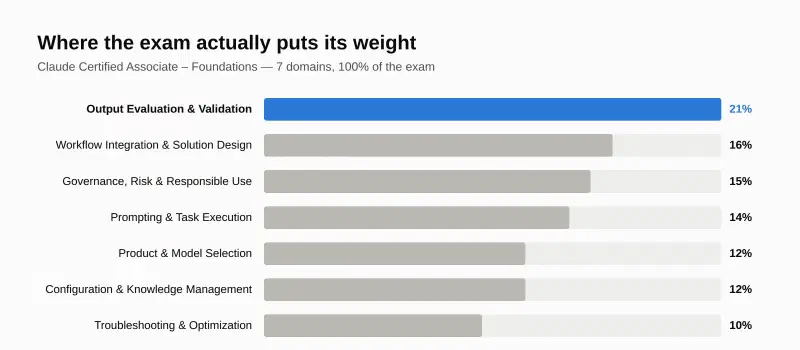
Domain 5 of the Claude Certified Associate – Foundations exam is Product and Model Selection. It’s worth 12%. The framing: before prompting even starts, four decisions already set the quality ceiling for the session — the right entry point, the right capability layer, the right model tier, the right context strategy. Get those four wrong and no amount of prompt polish fixes it. Get them right and the prompt has to do a lot less work.
Key point 1: pick the entry point by the job, not by habit#
Chat is for a one-off question or quick task with no recurring setup. A Project is for recurring work with stable context and a consistent output format. An Artifact is for a standalone, editable deliverable meant to outlive the chat. Research is for a deep, current, multi-source investigation with citations. Defaulting to Chat for everything is the most common mismatch — it works, but it throws away the context-carrying value the other three exist for.
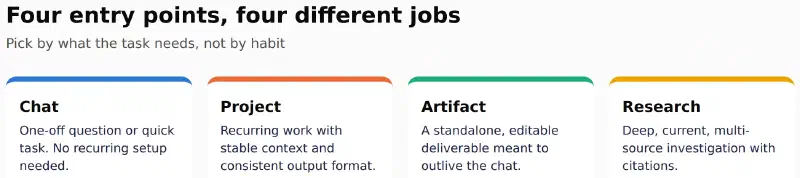
There’s a quick test for whether a Project is worth building at all: does the task recur, is the background context stable, is the output format consistent? If two or more of those are true, a Project usually pays for itself.
Key point 2: four capability layers, one memory hook#
Projects carry recurring context and standing configuration. Skills define a repeatable procedure. Code Execution verifies anything that needs to be computed rather than estimated. Memory persists relevant facts across sessions. The layers are independent and stack — a Project can use Skills, which can trigger Code Execution, in a conversation Memory also has context on. The shorthand worth remembering: Projects store knowledge; Skills perform tasks.
Key point 3: the Haiku / Sonnet / Opus decision frame#
Three tiers, matched to how structured and how consequential the task is. Haiku fits fast, structured, high-volume, low-ambiguity work — extraction, classification, formatting, straightforward summarization. Sonnet is the balanced starting tier for most professional work — drafting, synthesis, analysis, research assistance, document review. Opus earns its cost when the quality ceiling matters more than speed — nuanced judgment, complex multi-step reasoning, ambiguous inputs, high-stakes synthesis.
flowchart TD
    A[New task] --> B{Structured, high-volume,
low ambiguity?}
    B -->|Yes| C[Haiku
extraction, classification, formatting]
    B -->|No| D{Most professional work:
drafting, analysis, synthesis?}
    D -->|Yes| E[Sonnet
balanced starting tier]
    D -->|No, needs nuanced or
high-stakes judgment| F[Opus
quality ceiling over speed]

    style C fill:#86b6ef,stroke:#5598e7,color:#0b0b0b
    style E fill:#2a78d6,stroke:#1c5cab,color:#fff
    style F fill:#104281,stroke:#0d366b,color:#fff
The exam trap worth remembering: don’t reach for Opus just because the subject sounds important. If the task is highly structured, unambiguous, and high-volume, Haiku is usually the better answer regardless of how weighty the topic feels.
Key point 4: manage context before it degrades the output#
Long sessions lose early detail as context fills and gets compressed. When a conversation that worked well for a long time suddenly stops following an early instruction, the signal is context degradation, not a model-quality problem. The fix has three moves: restart a new conversation once the current one is no longer reliable; before restarting, write a state summary of decisions, progress, and unresolved questions, and start the new conversation from that; and persist anything that should outlive the conversation into Memory, Project knowledge, or standing instructions instead of re-explaining it every time.
Key point 5: web search, Research, Enterprise Search, or Thinking#
Four different retrieval and reasoning tools, easy to reach for the wrong one. Web search is for a quick current fact from a small number of sources. Research is for comprehensive, multi-source, citation-backed investigation and comparative synthesis. Enterprise Search is for internal organizational knowledge — policies, Slack, email, docs, cross-source company context. Thinking is for deep reasoning where external information isn’t the core need at all.
| Need | Reach for |
|---|---|
| Quick current fact | Web search |
| Comprehensive multi-source investigation | Research |
| Internal company knowledge across tools | Enterprise Search |
| Deep reasoning, no external lookup needed | Thinking |
Conclusion#
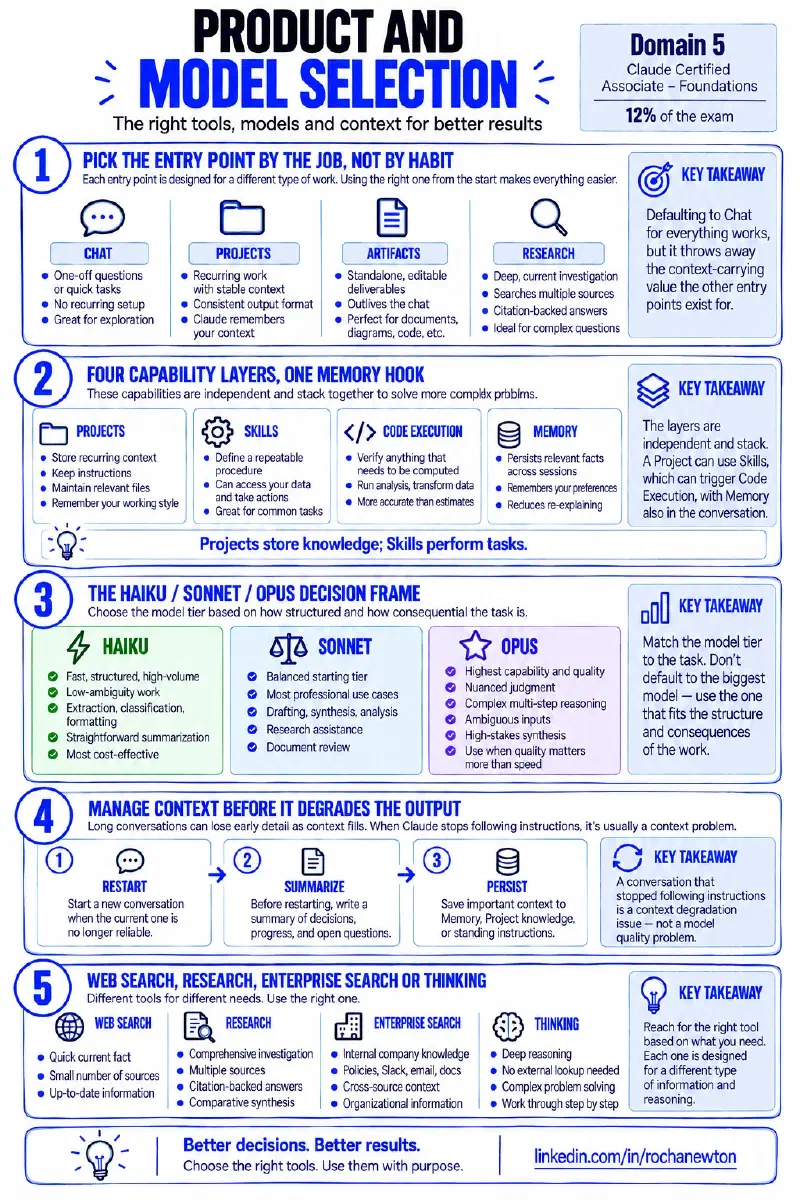
Domain 5 in one pass: pick the entry point that matches the job (Chat, Project, Artifact, or Research), know which of the four capability layers the task actually needs and remember Projects store knowledge while Skills perform tasks, match the model tier to how structured and consequential the work is instead of defaulting to the biggest model, and treat a conversation that stopped following instructions as a context problem to restart-summarize-persist through, not a model problem to fight. These four decisions happen before the prompt does any work at all.
Sources#
- Claude Platform & Model Foundations — Anthropic Partner Academy
- Claude Certified Associate – Foundations Exam Guide — official PDF
Where this fits#
Part 7 of Getting Claude Certified. Part 1 covered the 4D Framework, Part 2 covered Chat, Projects, Artifacts, and Research, Part 3 covered Domain 1 — Output Evaluation and Validation, Part 4 covered Domain 2 — Workflow Integration and Solution Design, Part 5 covered Domain 3 — Governance, Risk, and Responsible Use, Part 6 covered Domain 4 — Prompting and Task Execution. Part 8 takes on Domain 6 — Configuration and Knowledge Management.