
What this is about#
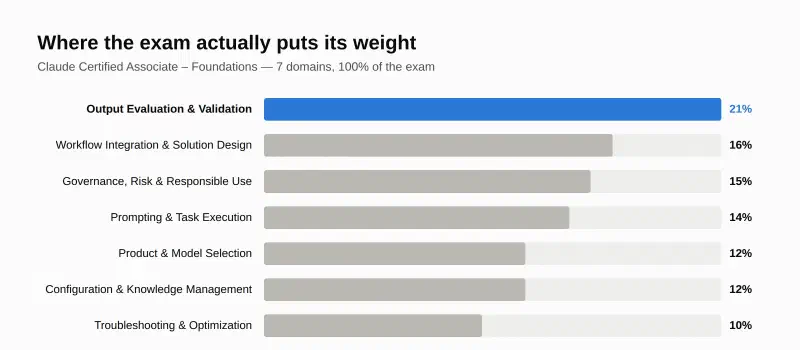
Domain 4 of the Claude Certified Associate – Foundations exam is Prompting and Task Execution. It’s worth 14%. The framing that matters here: ask Claude to “write something about our Q3 results” and you get a generic paragraph. Specify the audience, the three results that matter, the format, and the length, and you get a draft you can almost send. The model didn’t get smarter between those two requests. The prompt did. This domain treats prompting as a communication discipline with learnable structure, not a knack some people have.
Key point 1: the five-component stack#
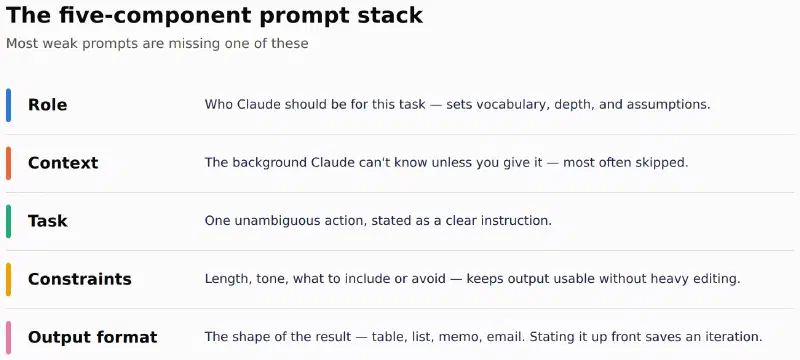
Five components carry almost all the weight in a professional prompt: Role (who Claude should be for this task), Context (the background Claude can’t know unless you give it), Task (one unambiguous action), Constraints (length, tone, what to include or avoid), and Output format (the shape of the result). Not every prompt needs all five — a quick question needs a task and maybe a constraint. Context is the one professionals skip most often, because it lives in your head and never makes it into the prompt.
Key point 2: decompose complex requests into ordered steps#
A request with several distinct stages packed into one prompt produces shallow work on every stage. “Evaluate these three vendors and tell me which to pick” forces Claude to invent criteria, apply them, weigh trade-offs, and recommend, all in one pass — you never see the reasoning. Break it into a sequence instead, and each step produces a checkable result before the next one runs.
flowchart LR
    A[Derive criteria
from requirements doc] --> B[Score each vendor
against those criteria]
    B --> C[Raise trade-offs
where vendors diverge]
    C --> D[Recommend
tied back to weighted criteria]

    style A fill:#2a78d6,stroke:#1c5cab,color:#fff
    style B fill:#2a78d6,stroke:#1c5cab,color:#fff
    style C fill:#2a78d6,stroke:#1c5cab,color:#fff
    style D fill:#1c5cab,stroke:#104281,color:#fff
If the criteria in step one are wrong, you catch it before scoring, not after the recommendation ships. Keep steps that build on each other in one conversation; split off into a new one only when a step is genuinely independent or the thread has grown long enough that early context is degrading.
Key point 3: iterate on the component that failed, not the whole prompt#
A first draft rarely lands perfectly, and the fix is never rewriting the whole prompt — that loses the parts that worked and hides which change actually fixed the problem. Read the output as a diagnostic instead: it points straight back to the component that fell short.
| Symptom | Likely cause | Fix |
|---|---|---|
| Output is generic or off-base | Context was thin | Add the background Claude couldn’t infer |
| Output answered the wrong question | Task verb was ambiguous | Sharpen the instruction |
| Output is the wrong length, tone, or shape | A constraint or format was missing | Add it |
| Output is close but misses one section | — | Iterate on that section only |
Change the one component the output told you to change, resend, and compare. Stop when a round produces marginal change instead of real improvement — at that point a quick manual edit beats another round of prompting.
Key point 4: match strategy to task type#
The five components apply everywhere, but the emphasis shifts with what you’re actually doing. Analysis wants tight constraints and explicit criteria — low creative latitude, high specification. Research wants clear scope and source discipline, with citations you can actually check. Drafting wants audience, tone, and format fixed, with room for Claude to find the phrasing. Brainstorming wants loose constraints and high latitude — over-specifying kills the range you’re after.
| Task type | Tighten | Loosen |
|---|---|---|
| Analysis | Criteria, standards, scope | Phrasing |
| Research | Question, sources, citations | Synthesis approach |
| Drafting | Audience, tone, format | Word choice |
| Brainstorming | Goal and guardrails only | Quantity and direction |
Key point 5: a weak prompt, repaired#
Weak: “Summarize the customer feedback and tell me what to do.” Output: a generic five-bullet list of themes, nothing tied to the actual data, nothing actionable — because the prompt specified almost nothing.
Repaired: “You are a product analyst (role). Attached are 200 customer survey responses (context). Identify the three most frequently raised issues, ranked by how many responses mention each (task), and for each include one representative verbatim quote and the approximate share of responses it appears in (constraints) — use code execution to count accurately rather than estimating. Format as a ranked list, most frequent first (output format).”
Same model, same data. The gap between the two outputs is entirely in the specification, not the underlying capability.
Conclusion#
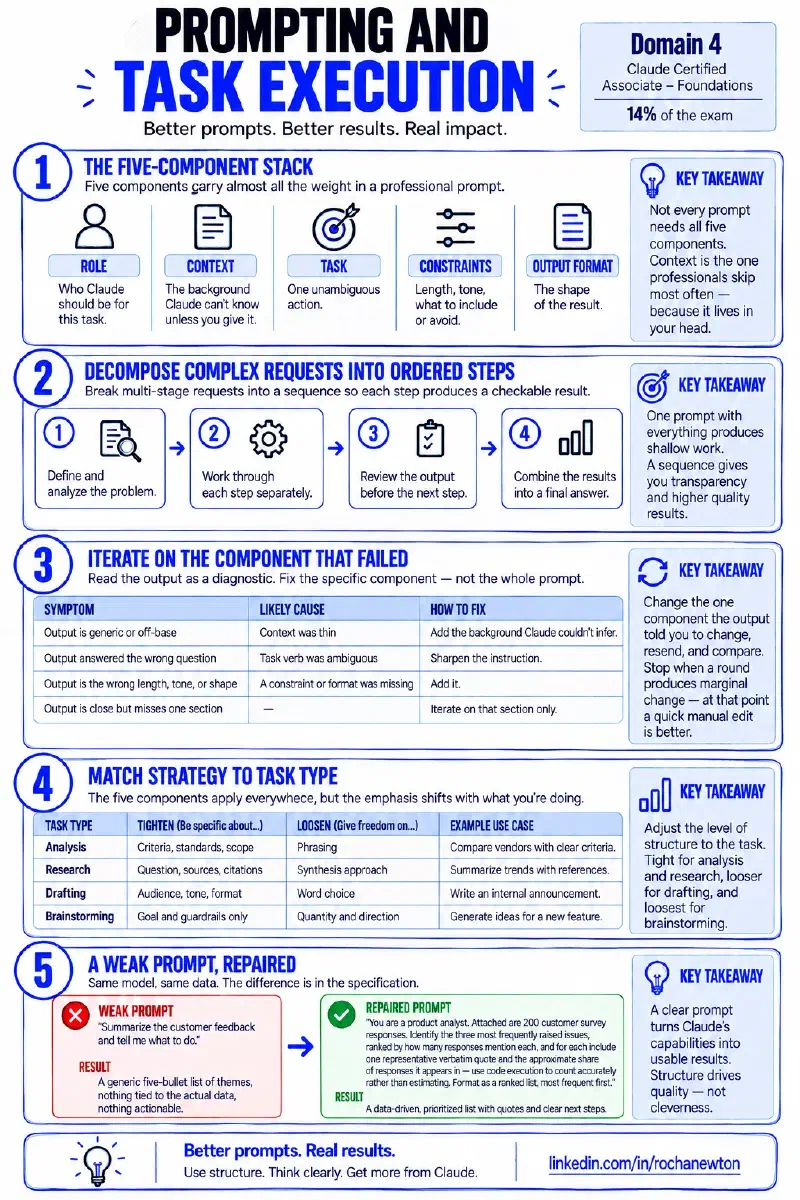
Domain 4 in one pass: run every non-trivial prompt against the five components (role, context, task, constraints, format), and expect context to be the one you forgot. Decompose multi-stage work into ordered steps so each one produces a checkable result before the next runs. When output disappoints, diagnose which component failed and fix only that — don’t start over. Match your specification style to the task: tight for analysis and research, looser for drafting, loosest for brainstorming. Structure drives quality here, not cleverness.
Sources#
- Prompting & Task Execution — Anthropic Partner Academy
- Claude Certified Associate – Foundations Exam Guide — official PDF
Where this fits#
Part 6 of Getting Claude Certified. Part 1 covered the 4D Framework, Part 2 covered Chat, Projects, Artifacts, and Research, Part 3 covered Domain 1 — Output Evaluation and Validation, Part 4 covered Domain 2 — Workflow Integration and Solution Design, Part 5 covered Domain 3 — Governance, Risk, and Responsible Use. Part 7 takes on Domain 5 — Product and Model Selection.