
What this is about#
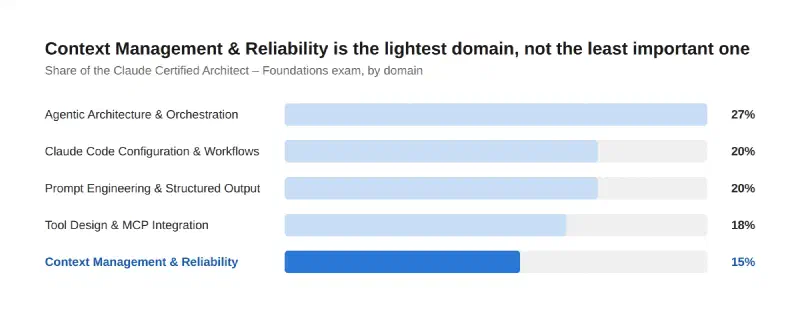
Domain 5 — Context Management & Reliability — is the lightest domain on the Claude Certified Architect – Foundations exam at 15%, but its six task areas cover what decides whether a long-running agent stays trustworthy: preserving critical facts across long interactions, knowing when to escalate, letting a multi-agent system recover from failure instead of silently degrading, managing context at scale, and calibrating how much to trust the output.
Key point 1: progressive summarization quietly deletes the facts that matter#
Condensing a long conversation into a summary is where information dies: dates, percentages, and a customer’s exact stated expectation get smoothed into vague prose, and the model’s own “lost in the middle” tendency means anything buried in a long input is less reliable than what’s near the start or end. The architect-level fix is to stop treating summarization as the only mechanism — extract transactional facts into a persistent, structured block (a “case facts” record) that survives independently of the narrative summary, trim verbose tool output before it accumulates rather than after, and put summaries at the beginning of a prompt to work with the position effect instead of against it.
Key point 2: escalation needs explicit triggers, not sentiment or confidence scores#
Neither sentiment analysis nor a model’s own confidence score is a reliable signal for when to hand off to a human — both can look calm on a case that’s actually stuck, or anxious on one that isn’t. The exam’s fix is explicit escalation criteria backed by few-shot examples: an outright customer request for a human gets honored immediately, a policy exception or gap escalates rather than getting worked around, and multiple ambiguous customer matches trigger a request for another identifier rather than a best-guess selection. The distinction that matters in practice: acknowledge frustration when it’s present, but don’t treat frustration itself as the escalation trigger when the issue is actually resolvable.
Key point 3: structured error propagation is what lets a coordinator actually recover#
A generic “failed” status thrown up from a subagent hides everything a coordinator would need to act intelligently. The pattern this domain tests: return structured error context — failure type, and what alternatives exist — rather than a bare status; distinguish a genuine access failure from a valid-but-empty result, since collapsing those two into “no data” produces the wrong recovery decision; attempt local recovery inside the subagent before propagating a failure upward at all; and when synthesizing results from several subagents, annotate the output with coverage gaps instead of silently presenting partial results as complete.
flowchart TD
    A[Subagent task fails] --> B{Recoverable locally?}
    B -->|Yes| C[Retry / fall back
inside subagent]
    C --> D[Return result]
    B -->|No| E[Return structured error:
failure type + alternatives]
    E --> F[Coordinator decides:
retry, reroute, or annotate gap]

    style D fill:#28c840,stroke:#1c9c30,color:#fff
    style E fill:#2a78d6,stroke:#1c5cab,color:#fff
    style F fill:#1c5cab,stroke:#14417f,color:#fff
Key point 4: large codebase exploration needs its own context discipline#
Extended sessions degrade — the exam names this directly, describing context degradation that produces inconsistent answers the longer a session runs. The countermeasures are concrete: scratchpad files that persist key findings across context boundaries so they survive even if the session doesn’t; spawning subagents to isolate verbose exploration, so the noise of searching a large codebase never enters the main conversation; summarizing a phase’s findings before delegating the next one, rather than letting raw exploration compound; designing state exports specifically for crash recovery; and using Claude Code’s /compact command during a long session to reclaim space with instructions about what to preserve, rather than letting auto-compaction guess.
Key point 5: calibrate confidence and preserve provenance — don’t trust an aggregate number#
An aggregate accuracy metric can hide a model that’s excellent on one document type and unreliable on another; the fix is stratified random sampling across segments, not a single overall percentage, plus field-level confidence scores calibrated against a labeled dataset so low-confidence extractions route to human review before they ship. The same discipline applies to multi-source synthesis: source attribution gets lost the moment a fact is summarized without its origin, so structured claim-to-source mappings (URL, excerpt, publication date) need to survive synthesis intact, conflicting statistics from credible sources should be shown side by side with attribution rather than silently merged into one number, and anything time-sensitive needs its collection or publication date carried through rather than presented as current.
How much this matters#
Conclusion#
Domain 5 in one pass: summarization silently deletes hard facts unless you extract them into a structured record that survives independently, and the lost-in-the-middle effect means position in the prompt matters as much as content. Escalation needs explicit, example-backed triggers — sentiment and confidence scores aren’t reliable signals on their own. Structured error propagation, with a real distinction between failure and empty-but-valid, is what lets a multi-agent system recover instead of quietly degrading. Large codebase exploration needs scratchpads, subagent isolation, and deliberate compaction to avoid context rot. And trust in output comes from stratified sampling and calibrated confidence scores, not an aggregate accuracy number — paired with provenance that survives synthesis instead of dissolving into it.
Sources#
- Claude Certified Architect – Foundations Exam Guide — Domain 5 task statements
- Context editing — Claude Platform Docs — automatic tool-result clearing, the memory tool
- Manage costs effectively — Claude Code Docs —
/compact, context management in long sessions - Best practices for Claude Code — Claude Code Docs — subagent delegation for verbose exploration
The research and the technical accuracy check against the official docs are AI-assisted; the framing, the “what this means for the exam” judgment calls, and any war stories are mine.
Where this fits#
Part 6 of Becoming a Claude Architect, following Domain 4 — Prompt Engineering & Structured Output. Part 7 wraps the series with a 100-question interactive practice quiz across all five domains.