
What this is about#
Claude Certified Architect – Foundations is Anthropic’s certification for designing Claude systems, not just using them. Where the Claude Certified Associate exam tests whether you can operate Claude with professional discipline — good prompts, sound judgment on output, the right entry point for the job — the Architect exam tests something a level up: can you design the agentic system, the tool integrations, and the configuration that other people build on top of. The ideal candidate has 6+ months of hands-on experience building with the Claude API, the Claude Agent SDK, Claude Code, and Model Context Protocol (MCP) — this isn’t a first certification, it’s the next one.
This kicks off a new series, Becoming a Claude Architect, separate from my Getting Claude Certified series on the Associate exam. If you haven’t sat that one yet, it’s the natural place to start — this series assumes the fluency habits from that one are already in place.
Key point 1: the exam, by the numbers#
60 items, multiple-choice and multiple-response, 120 minutes, delivered proctored online or at a test center. Passing is a scaled score of 720 on a 100–1,000 scale — Anthropic doesn’t publish the raw-to-scaled conversion, so “720” isn’t “72% of questions right,” it’s a calibrated bar. The credential costs $125 and stays valid for 12 months, and scoring comes back as pass/fail plus a percent-correct breakdown by domain, so you know exactly where a retake needs to focus.
Key point 2: five domains, one clear heaviest#
flowchart LR
    A[Agentic Architecture
& Orchestration — 27%] --> F[Architect exam]
    B[Claude Code Configuration
& Workflows — 20%] --> F
    C[Prompt Engineering
& Structured Output — 20%] --> F
    D[Tool Design
& MCP Integration — 18%] --> F
    E[Context Management
& Reliability — 15%] --> F

    style A fill:#2a78d6,stroke:#1c5cab,color:#fff
    style B fill:#86b6ef,stroke:#5598e7,color:#0b0b0b
    style C fill:#86b6ef,stroke:#5598e7,color:#0b0b0b
    style D fill:#c9ddf6,stroke:#86b6ef,color:#0b0b0b
    style E fill:#c9ddf6,stroke:#86b6ef,color:#0b0b0b
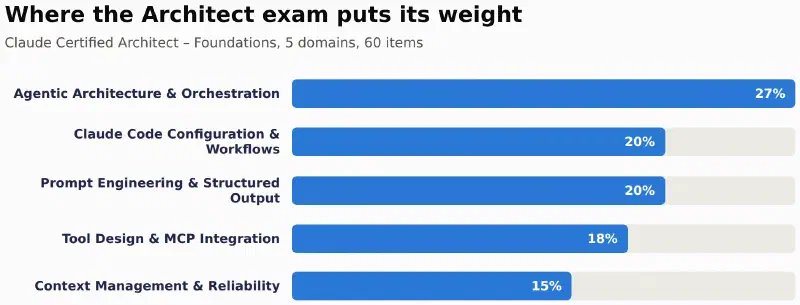
Agentic Architecture & Orchestration carries more weight than any other single domain — over a quarter of the exam — which tells you where Anthropic thinks the real skill gap sits between someone who uses Claude well and someone who architects Claude systems: not in knowing the API surface, but in designing how autonomous work gets orchestrated, handed off, and kept reliable.
Key point 3: usage skill and architecture skill are different exams for a reason#
Being good at prompting doesn’t automatically make someone good at deciding when a workflow should become a multi-agent system, what a tool’s interface should look like to an LLM calling it blind, or how a Claude Code deployment should be configured so a team can trust it in production. The Associate exam tests judgment inside a single conversation. The Architect exam tests judgment about the system around the conversation — the parts a single good prompt can’t fix.
Key point 4: what this series covers#
Six more posts follow this one, each taking on one domain in the order of the exam guide: Agentic Architecture & Orchestration, Tool Design & MCP Integration, Claude Code Configuration & Workflows, Prompt Engineering & Structured Output, and Context Management & Reliability. The series closes with a 100-question interactive practice set — 20 per domain, click an answer and see immediately whether it’s right — built as an unofficial study aid once all five domain posts are written.
Conclusion#
Claude Certified Architect – Foundations in one pass: it’s the next certification after Associate, not a harder version of the same one — it tests systems design, not usage discipline. 60 items, 120 minutes, a scaled 720 to pass. Agentic Architecture & Orchestration is the domain to take most seriously at 27% of the exam, with Claude Code Configuration & Workflows and Prompt Engineering & Structured Output tied right behind it at 20% each. Six domain-by-domain posts and a practice quiz follow.
Sources#
- Claude Certified Architect – Foundations Certification — Anthropic Partner Academy
- Claude Certified Architect – Foundations Exam Guide — official PDF
Where this fits#
Part 1 of Becoming a Claude Architect. This series follows on from Getting Claude Certified, my 9-part series on the Claude Certified Associate – Foundations exam — start there if you’re newer to Claude. Part 2 takes on Domain 1 — Agentic Architecture & Orchestration.